Katerini Tunnel T4
Automation in the Service of Safety
A separator rated at 10,000 liters per hour does not make a plant that produces 10,000 liters per hour.
We see this every time we are called into an operating dairy plant. The losses are rarely dramatic. A few minutes between fermentation and cooling. A transfer that slows as the product thickens. A CIP cycle that blocks a route another line needs. Each looks acceptable on its own; together, they determine the plant’s actual shipping volumes. And sometimes the plant’s own data reveals that the capacity that seemed to be missing was never missing at all – it was simply poorly allocated.
This holds for every yogurt type – set, stirred, drinkable or strained. Concentrated, high-protein products such as Greek yogurt and skyr simply make it harder: concentration affects how the product flows, the level of mechanical treatment it can tolerate, and how precisely every downstream step must be coordinated.
With over 30 years of experience and more than 1,000 projects across 17 countries – including over a decade of collaboration with Kri Kri, one of Greece’s leading yogurt producers – we have learned to approach every project by understanding how the entire system behaves, rather than simply looking at the equipment list. These are the five decisions that matter most.
Milk composition varies with the season. Recipes differ in fat and protein. Yogurt cultures behave differently. The cooling profile determines how fermentation is halted and how well the yogurt’s texture is preserved. These are usually specified as separate requirements, but they are linked: formulation drives viscosity, viscosity drives how the product moves, and that in turn affects pump duty, pressure, filling times and, eventually, throughput.
Each yogurt type presents its own processing challenges. In stirred and drinkable yogurt production, the coagulum is broken after fermentation and pumped through the downstream process, so excessive shear can directly reduce the product’s viscosity. In set yogurt, fermentation takes place in the final package, so the product develops its texture undisturbed. The critical interfaces therefore move to filling, incubation and cooling logistics. In strained, high-protein products such as Greek yogurt and skyr, the product leaving the concentration step – whether by centrifugal separation, ultrafiltration or traditional straining – behaves very differently from the fermented base entering it.
So before selecting equipment, we ask:
Engineering insight: Size pumps, pipes and pressure control for the most demanding recipe, not the average one.
A line that runs smoothly on a standard stirred yogurt can struggle with a high-protein strained product. The full product range belongs in the design brief from day one.
Plants are specified machine by machine: the pasteurizer’s rating, the separator’s capacity, tank volumes, filler speed. But a plant produces according to how those pieces interact:
None of these is a breakdown. Each one reduces real output.
The useful question, then, is not “Can this machine process 10,000 l/h?” but “Can the plant sustain 10,000 l/h once filling, fermentation, holding, transfers, cleaning and packaging availability are counted?”
Fermentation makes this especially sensitive. Tanks are occupied for hours, so tank availability becomes a scheduling constraint rather than a storage question. Buffers, valve routing, transfer sequences and intermediate holding must be designed together with the cleaning philosophy.
Engineering insight: Map waiting time, not just processing time.
For every stage we chart two things: where equipment waits for product, and where product waits for equipment. The gaps that show up rarely appear in any single machine’s specification.
Flexibility has to be built in mechanically, too. A line designed around only one dominant recipe becomes a constraint as the portfolio grows – and no software update can fix an undersized pipe or a missing route.
CIP is usually discussed in terms of hygiene and food safety. It is also production time: every cycle occupies equipment, routes and utilities that cannot produce at the same time.
Dairy soils – protein, fat, milkstone – are demanding, and heated surfaces need different programs from tanks and piping. Centralized CIP suits compact plants with similar cleaning needs; distributed units suit plants whose areas differ or must be cleaned in parallel. There is no standard answer, and two designs can deliver the same cleaning result while one restricts production far more than the other.
It also means the obvious fix for a cleaning bottleneck – more CIP units – is not always the right one. At a Greek dairy, the original plan was to add two new CIP units to relieve the existing stations. Before the second unit was committed, the client reviewed actual cleaning loads and schedules in AS Analytics. The data showed that, once cleaning programs were reallocated, the existing stations plus one new unit could cover the yogurt process. The second unit was not needed as a standalone system. Its pump, heat exchanger, instrumentation, valves and steam equipment were reused in a new two-line central CIP instead.
The result: no unnecessary capacity, more efficient use of existing CIP resources, and one fewer equipment package to invest in.
Engineering insight: Design cleaning around the production schedule.
Before defining circuits, decide which equipment must be available simultaneously, which areas must be cleaned in parallel and where cleaning will collide with production. Then check the plan against real cleaning data. The goal is less CIP-related downtime at the same hygiene standard – not simply more cleaning capacity.
Opening valves automatically is not process automation. The value comes when the control system knows when a transfer may start, when fermentation has reached its end point, whether the next unit is free and what to do if a parameter drifts outside its window. That reduces dependence on individual operators’ judgment and makes the process repeatable across shifts, batches and recipes.
For every yogurt type, flow, pressure, temperature and sequencing are part of how texture is protected – not just equipment settings. In Greek yogurt, skyr and other concentrated products, where the product behaves differently after concentration, the margin for getting them wrong is smallest.
Engineering insight: Automate the decision points.
The strongest architecture is one where the system knows the conditions required to proceed, and responds the same way every time they are not met. That is how engineering know-how ends up embedded in daily operation instead of in the heads of a few experienced operators.
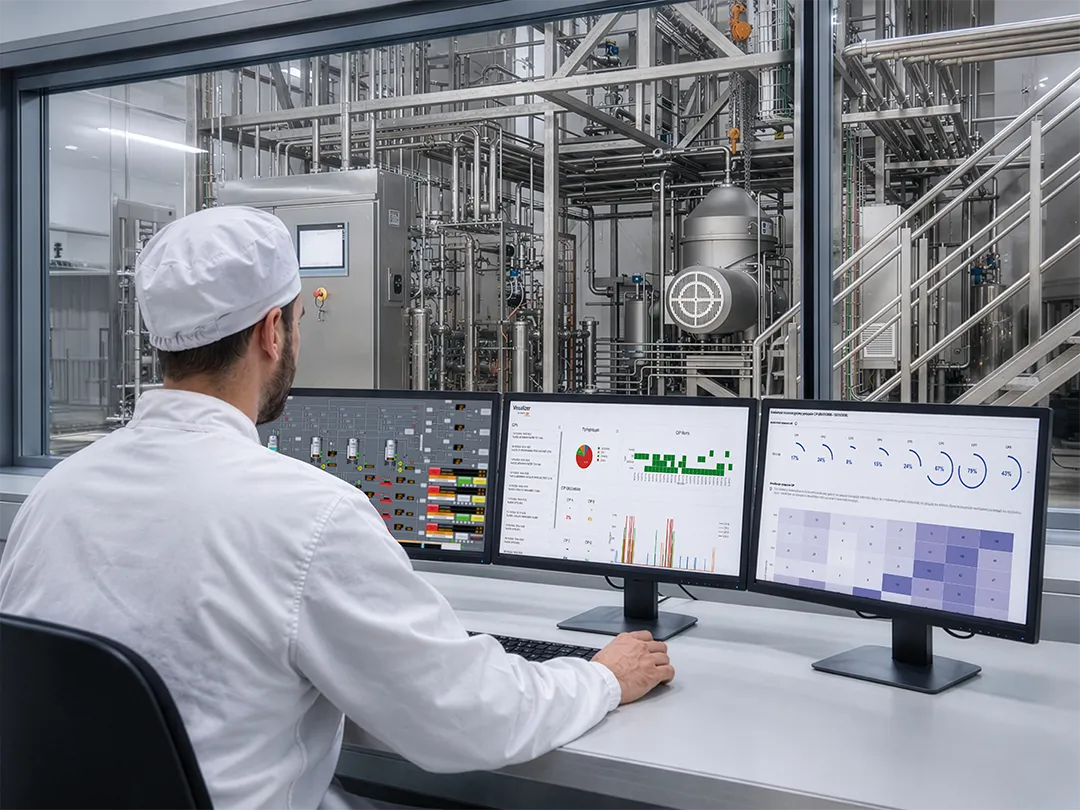
Dairy plants already generate plenty of data: PLC and SCADA records, CIP logs, ERP batches, quality results. The problem is fragmentation. The plant knows output has dropped, but it takes hours to find out why.
OEE shows that a machine is underperforming; it rarely shows the cause. That usually sits upstream – in tank availability, recipe timing, a slow transfer, product loss or a long CIP cycle. Useful analytics follow the whole chain and answer specific questions:
Engineering insight: Begin with the question, then find the data.
If the question is “Why are we not reaching planned output?”, the answer usually requires combining tank occupancy, recipe timing, transfer delays, CIP performance and packaging availability.
Done consistently, this produces measurable results. Kri Kri’s yogurt plant in Serres is one example. After a fire in 2013, the plant was rebuilt in just six months with Siemens automation, with AS Hellas as Siemens Solution Partner. It has since become a fully digital production environment. Its performance is tracked through AS Analytics, our platform built on Siemens Xcelerator and other technologies. The results so far:
AS Analytics connects production, process and CIP data into one view of the line. It flags developing problems early – CIP cycles creeping longer, recurring stops, parameter drift – and, as the CIP example above shows, it can change an investment decision, not just a report.
Good machines are necessary, but they do not make a high-performing yogurt plant. Performance comes from engineering the relationships between product behavior, mechanical design, scheduling, cleaning, automation and data – and strained, high-protein products leave the least room for error in any of them.
That is why we approach every line as one production system, from the behavior of the product to the last transfer before the filler.
Planning a new yogurt line, or trying to recover capacity in an existing one? Our process team can map where your plant is losing time. Contact us at sales@ashellas.com.