Katerini Tunnel T4
Automation in the Service of Safety
A software update, stricter access controls or the replacement of an older system may improve security. Without proper assessment, however, the same intervention may affect compatibility, availability and the smooth operation of the facility.
Cyberattacks and the European Union’s NIS2 Directive did not create the need to protect industrial systems. They have, however, brought longstanding challenges into sharper focus. For companies falling within the scope of Greek Law 5160/2024, which transposed NIS2 into Greek law, managing cybersecurity risks is now a clear regulatory obligation. Compliance alone, however, is not enough to ensure that production processes are genuinely protected.
In industrial Operational Technology (OT) environments, knowing how to protect a system is not enough. You also need a thorough understanding of what it does, how it interacts with other systems and which production processes depend on it. Effective OT cybersecurity does not begin with selecting a product, nor does it end with meeting a regulatory requirement. It starts with a deep understanding of production processes, the people who manage them and the systems that support them.
The criticality of a system is determined not only by its technology, but also by its role in production. Two real-world examples from AS Secure Ops projects, AS Hellas’ OT cybersecurity service, demonstrate how this understanding shapes security decisions.
To protect confidentiality, the examples do not identify customers, and certain technical details have been generalized.
How do you protect a critical industrial facility when its equipment has been operating for 18 years, but its production process cannot accommodate prolonged downtime?
We faced precisely this challenge in a project in the oil and gas sector. The facility had an automation system approximately 18 years old, consisting of programmable logic controllers (PLCs) and a supervisory control and data acquisition (SCADA) system. The SCADA computer was still running Windows XP, while communications used the S7 protocol without encryption over a single industrial network.
Although the equipment continued to meet the facility’s operational needs, it had significant limitations in supporting modern cybersecurity mechanisms.
The critical consideration was the system’s role in the safe operation of the facility. A complete replacement was estimated to require around 16 hours of downtime, a substantial interruption for this particular operation.
We considered three options: complete replacement, a partial upgrade, or retaining the equipment with additional protective measures. After assessing the risks, compatibility and available downtime, we chose to isolate the existing system at the network level, without extensive changes to the automation system.
The outcome was measurable: network isolation was completed with just two hours of downtime, compared with an estimated 16 hours for a complete replacement. This intervention reduced exposure to specific risks while preserving the system’s existing functionality.
The two interventions do not necessarily provide equivalent levels of protection.
The case illustrates why immediate replacement of older technology is not always the most appropriate option. Targeted measures can improve protection without eliminating the equipment’s inherent vulnerabilities. A future upgrade remains a matter of documented planning and risk assessment.
Remote access is essential for technical support at many industrial facilities. But is having a secure VPN connection enough?
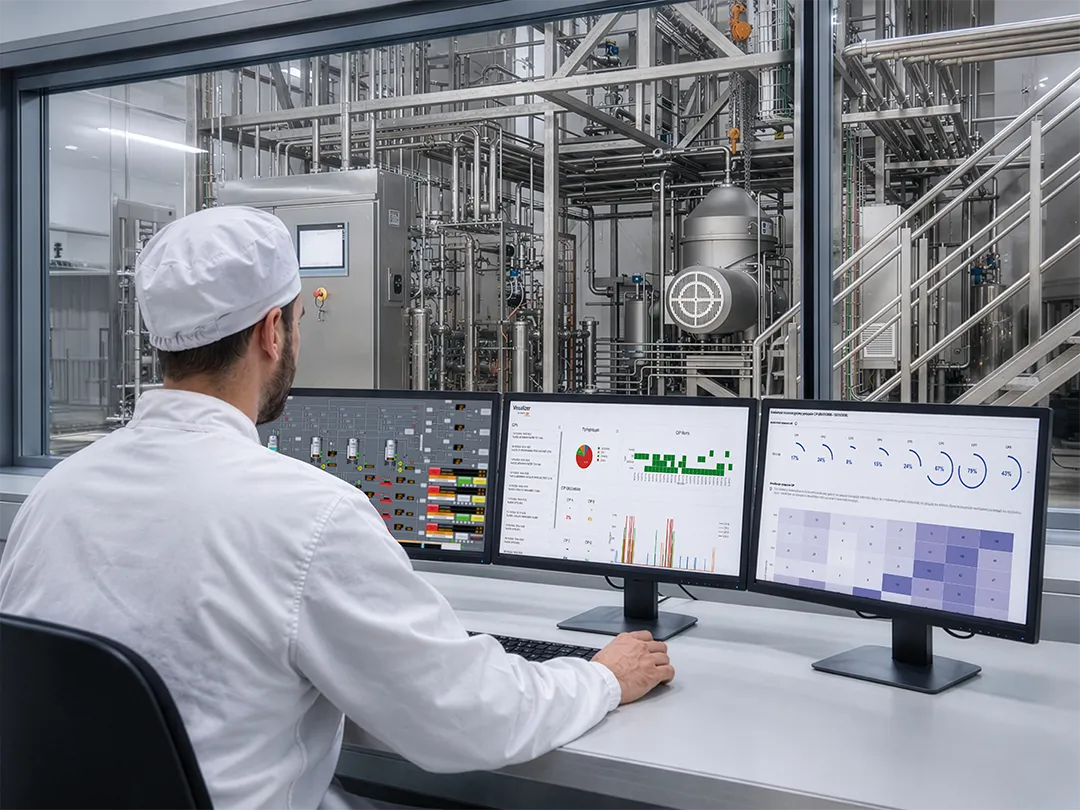
During a project in the food industry, we identified four VPN routers, two of which were unknown to those responsible for the facility. This meant that the company did not have a complete picture of all the remote-access paths into its production systems.
The answer was not simply to restrict connections. Immediate technical support had to remain available, as different subcontractors needed access to different machines and had different responsibilities.
We redesigned the remote-access setup around role-based and system-specific permissions, approval procedures and connection logging. This enabled the facility to control who connected, where and when, without granting broad access to the industrial network.
We also established a procedure for urgent support outside normal working hours: an authorized person can promptly approve access for a specific technician, limited to the required system and a defined period, with the connection logged and monitored.
The lesson is that a secure connection does not automatically mean secure access management. In OT cybersecurity, we need to know not only who is connecting, but also why, to which system and under what restrictions, so that protection supports day-to-day operations.
The two cases highlight different aspects of the same challenge. In the first, security for an older system had to be improved with minimal operational disruption. In the second, remote access had to be organized without compromising essential technical support.
In both cases, the solution emerged from more than an assessment of technical vulnerabilities. It came from understanding the facility, its production requirements and the consequences of each potential intervention.
Security measures must therefore be designed around not only the technology itself, but also the operational importance of each system to production.
This is precisely the thinking behind AS Secure Ops, AS Hellas’ approach to cybersecurity for industrial facilities.
Our experience in industrial automation enables us to approach cybersecurity with the facility’s actual operational requirements in mind.
The process begins with mapping and understanding the existing infrastructure, continues with risk assessment and prioritization, and leads to the design and implementation of appropriate technical and organizational security measures.
The key question for an industrial company is not simply which vulnerabilities exist in its systems. It is which of those vulnerabilities present a real operational risk, which must be addressed first, and how suitable interventions can be implemented without disrupting the facility’s operations.
OT cybersecurity should not be an obstacle to industrial operations. It should create the conditions for industry to operate, collaborate and evolve securely.
Iakovos-Argyrios Stavropoulos is Computer Engineering Projects Manager at AS Hellas and Head of AS Secure Ops.
AS Secure Ops | Contact
For more information about AS Secure Ops and the possibility of an initial cybersecurity assessment for an industrial facility, contact AS Hellas at sales@ashellas.com.