Katerini Tunnel T4
Automation in the Service of Safety
AS HELLAS | Building Automation
In a conventional building, a BMS malfunction may lead to higher energy consumption, less-than-ideal comfort conditions or temporary equipment disruption. In a Data Center, power supply, cooling and environmental conditions are directly linked to the ability of the IT infrastructure to remain operational.
This is why the BMS must be treated as part of a mission-critical ecosystem. The question is not simply “how many points are we monitoring?”, but how to design a system that operates 24/7, integrates critical subsystems, identifies deviations early and can evolve along with the Data Center.
Availability and redundancy: what happens when something fails?
In a mission-critical environment, design cannot be based on normal operating conditions alone. A server, controller, network path or third-party system interface may become unavailable.
The critical question is not only whether the BMS works when everything is operating normally. It is what continues to work when something fails.
Redundancy, therefore, does not simply mean “two servers”. The architecture must consider the supervisory layer, controllers, communication paths, integration points and the required level of local autonomy. The BMS should support the resilience of the facility – not introduce a new single point of failure.
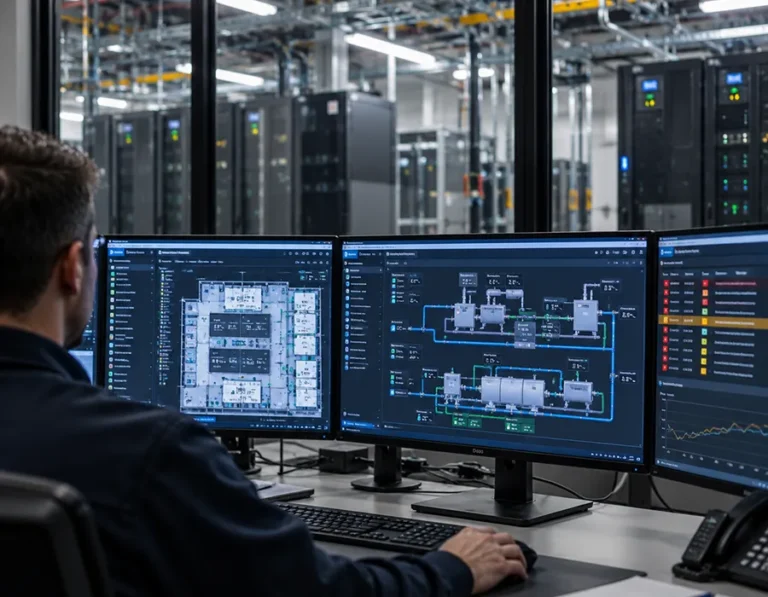
Cooling/HVAC, energy monitoring, water systems, environmental monitoring and equipment from different manufacturers continuously generate information. The value of the BMS lies in turning that information into a coherent operational view.
In modern Data Centers, the BMS does not operate in isolation. It often coexists with EPMS (Electrical Power Monitoring Systems) for monitoring the electrical infrastructure and DCIM (Data Center Infrastructure Management) platforms for managing and analysing operational data. Clearly defining the role of each system, together with reliable data exchange between them, is a critical part of the overall design.
This level of integration requires more than a communication driver. It must be clear which data is exchanged, which system is responsible for control, what happens if communication is lost, which alarms are transferred and how each interface will be tested. Open and widely supported protocols such as BACnet/IP and Modbus TCP facilitate interoperability. On their own, however, they do not guarantee successful integration: that requires experience in system design, integration and functional verification.
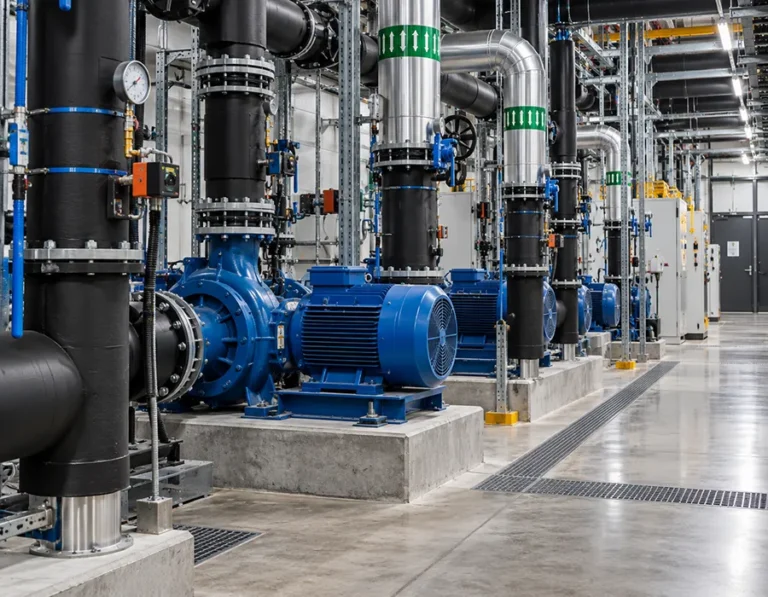
Cooling is one of the most important functions in a Data Center and one of the areas evolving most rapidly. The growth of AI and High-Performance Computing (HPC) is increasing thermal loads and accelerating the adoption of new cooling architectures, including liquid cooling where appropriate.
For the BMS, this means scalability is not simply the ability to add more points. It is the ability to integrate new sensors, hydraulic circuits, cooling equipment, interfaces and sequences of operation without redesigning the core system.
A Data Center can generate a vast volume of measurements, states and alarms. More data, however, does not automatically mean better visibility.
The BMS should help the operator answer quickly: What happened? Where? How critical is it? What else is affected? Is immediate action required?
Alarm prioritisation, trends, historical data, appropriate graphics and role-based access should therefore be designed around real operational needs. The goal is not more dashboards. It is better operational awareness.
Energy performance is becoming increasingly important because of cost, sustainability and reporting requirements. One of the key metrics is Power Usage Effectiveness (PUE), the ratio of the total energy consumed by a Data Center to the energy consumed by the IT equipment itself.
PUE remains a key international metric, while requirements in Europe for collecting and reporting data on the energy and environmental performance of Data Centers are becoming more stringent.
At the same time, the more systems are interconnected, the more important OT cybersecurity becomes. Access rights, network segmentation, backups, version control, software lifecycle management and controlled change management must be built into the engineering process. In a 24/7 facility, even a necessary upgrade must be assessed for its operational impact before it is implemented.
A controller may be operating correctly. So may a cooling unit. The supervisory software may be displaying the correct values. None of this proves that the Data Center will behave as intended when a real failure occurs.
This is why commissioning must address not only individual equipment but integrated systems as well. Simulation, FAT, installation and communication verification, commissioning, SAT and Integrated Systems Testing (IST) create a chain of verification that confirms interfaces, alarms and sequences of operation perform as designed.
In a mission-critical environment, testing is not simply confirmation that the installation has been completed. It is the process by which the system’s behaviour is proven.
The Data Center at handover will not be the same Data Center five or ten years later. Loads, equipment, cooling technologies, integration points, software versions and cybersecurity requirements will change.
Scalability must therefore be a design requirement from day one. Obsolescence management must be planned alongside it: software lifecycle, hardware replacement, backward compatibility, spare parts, third-party dependencies, backups and controlled upgrades.
The right BMS is not designed only for Day 1. It is designed to remain maintainable, supportable and scalable well into the future.
What Data Center owners and operations teams expect from a BMS today
Beyond monitoring and controlling MEP systems, the BMS in modern Data Centers is increasingly regarded as an important element of the facility’s overall operational resilience.
Key requirements include:
In practice, operations teams need more than a monitoring system. They need a platform that contributes to the Data Center’s availability, security and future evolution.
Controllers, sensors, redundant servers and modern software platforms are essential. On their own, however, they do not guarantee a successful BMS.
In Data Centers, a significant part of the value lies in the quality of the engineering and system integration. The Systems Integrator must understand automation, MEP systems, networks, interfaces and Sequences of Operation – and be able to cover the full journey from engineering and automation panels to software, integration, testing, commissioning, documentation and lifecycle support.
Data Centers are evolving rapidly. AI workloads, higher power densities, new cooling technologies and growing energy-efficiency requirements are changing both their design and operation.
Within this environment, the role of the BMS is changing as well. It is not simply the system that displays temperatures and alarms. It is the platform that must provide a timely and reliable view of the facility’s actual condition, integrate different systems and support its safe evolution over time.
In a Data Center, the Building Management System is not only about managing the building. It is about managing continuity of operations.
AS HELLAS approaches Building Automation projects as a Systems Integrator, combining expertise in building automation, MEP systems and the integration of different technologies into a unified operating environment. Its recent experience in large-scale Data Center projects spans BAS engineering, automation panels, system integration, software configuration, testing, commissioning and documentation.
As a “Siemens Advanced Partner – Building Automation”, AS HELLAS also brings specialised expertise in Siemens Building Automation technologies and in delivering complex applications where availability, integration, scalability and long-term support are fundamental requirements.
Are you designing or building a Data Center? Talk to the AS HELLAS Building Automation team about your BMS/BAS requirements from the earliest stages of the project: sales@ashellas.com